Strategic Energy and Infrastructure
Act of Canada
A plain-language public guide and fictional federal statute — for Canadians who want to understand energy prices, national infrastructure, and how to make their voices heard.
1. Plain-Language Overview
Canada is one of the world's largest producers of oil, natural gas, hydroelectric power, and uranium. And yet Canadians in many regions regularly pay world-level — or even higher — prices at the gas pump, on their electricity bills, and for home heating fuel.
Why? The short answer is that having resources in the ground is not the same as having them where people need them, at prices they can afford. Getting energy from where it is produced to where it is used — across a country as large as Canada — requires pipelines, power lines, and transportation corridors that cross multiple provincial borders. And building those corridors involves complex legal, political, and environmental challenges.
The Strategic Energy and Infrastructure Act of Canada (the "Act") is a fictional federal law designed to help solve this problem. It would give the federal government carefully limited, temporary powers to coordinate energy and infrastructure when provinces cannot agree, when a national emergency strikes, or when the country's energy security is at risk.
2. Why Are Prices High If Canada Has So Much Energy?
This is one of the most common and understandable frustrations Canadians feel. Here is a plain-language breakdown of the main reasons.
2a. Global Pricing — Your Local Gas Station Is Connected to the World
Crude oil and natural gas are traded on world markets. Even if a barrel of Alberta oil is sitting a few hundred kilometres from your home, its price is largely set by global supply and demand — in the same way that the price of wheat in Saskatchewan rises and falls with world markets, not just local harvests.
2b. Limited Pipeline Capacity to Tidewater
Canada produces enormous amounts of oil and gas, mostly in the west. But much of that energy cannot reach world markets easily because there are not enough pipelines running to tidewater (ocean ports). Without access to tidewater, Canadian oil often must be sold at a discount to American refiners — meaning Canadians effectively subsidize American buyers rather than benefiting from world prices themselves.
2c. Refining Capacity and Regional Bottlenecks
Canada exports large amounts of raw (unrefined) crude oil and imports refined products like gasoline and diesel — often at higher prices. Canada has relatively limited domestic refining capacity, and what exists is geographically concentrated. This means that even regions sitting near oil sands may import refined gasoline from overseas or from the United States.
2d. Transportation and Regulatory Delays
Building new pipelines or upgrading existing ones in Canada involves navigating federal and provincial environmental reviews, Indigenous consultation requirements, and court challenges. These processes are important and necessary — but they can take years or even decades, during which bottlenecks persist and prices remain higher than they might otherwise be.
2e. Carbon Pricing and Taxes
Provincial and federal carbon pricing, fuel taxes, and excise duties add to the cost of energy at the pump or on the bill. These policies exist for environmental reasons, but they do contribute to the price Canadians pay.
3. Why National Corridors Matter
A national corridor is a designated route — on land, under rivers, or through mountains — where pipelines, electrical transmission lines, fibre-optic cables, rail lines, and other critical infrastructure can be built and maintained with greater regulatory certainty.
3a. More Stable Prices
When energy can flow freely across the country, regional shortages and surpluses balance out. Eastern Canada and British Columbia would be less dependent on imports. Alberta and Saskatchewan could access better prices for their exports. Greater competition among suppliers generally puts downward pressure on prices consumers pay.
3b. National Resilience in Crises
Wars, pandemics, severe weather, cyberattacks, and trade disputes can all disrupt energy supplies. A country with well-connected internal infrastructure can reroute energy domestically when foreign supplies are cut off. Without that internal connectivity, a trade dispute or global supply shock can immediately translate into shortages and price spikes at home.
3c. Supporting Domestic Needs and Export Capacity
Corridors are not just about exports. Hydroelectric power from Quebec and Labrador could more easily power Ontario and the Maritimes. Wind energy from the Prairies could supplement power grids in British Columbia. Tidal and solar energy from Atlantic Canada could reach new markets. The country's energy potential is vast — but only accessible with the right connections.
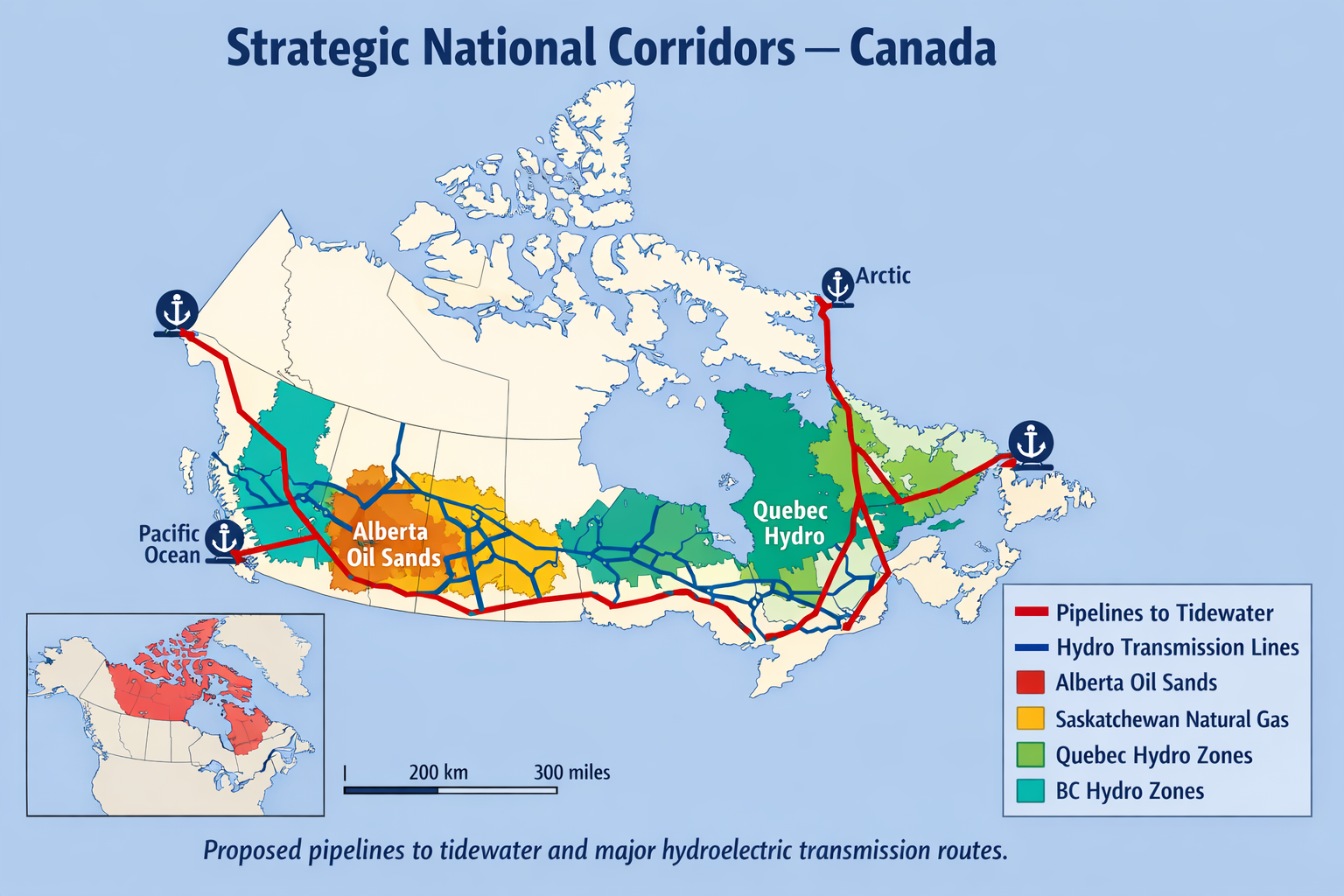
Proposed pipelines to tidewater and major hydroelectric transmission routes.
4. Summary of the Strategic Energy and Infrastructure Act of Canada
What the Act Is
The Strategic Energy and Infrastructure Act of Canada (SEIAC) is a fictional federal statute grounded in existing constitutional powers. It is designed to fill a gap in Canadian law: the absence of a clear, principled framework for federal coordination of energy infrastructure in true national emergencies, while respecting the legitimate interests of provinces and Indigenous peoples.
What the Act Is Not
- It is not a permanent federal takeover of energy resources, which belong to the provinces under the Constitution.
- It is not a mechanism for overriding Indigenous rights or treaty rights.
- It is not a tool for any political party to advance partisan interests.
- It is not currently law in Canada.
Key Features at a Glance
- Designates Strategic National Corridors for pipelines, power lines, water systems, and communications infrastructure.
- Provides a clear trigger mechanism — the Act only activates under defined, serious national circumstances.
- Grants temporary, proportional federal coordination powers with mandatory sunset clauses.
- Requires meaningful consultation with Indigenous peoples even in emergencies.
- Includes compensation mechanisms for provinces and affected communities.
- Subject to parliamentary, judicial, and independent review.
5. Key Legal Provisions — Statute Text
The following is the fictional statute text of the Strategic Energy and Infrastructure Act of Canada, drafted in the style of Canadian federal legislation. Each section is followed by a plain-language explanation in a coloured box.
PART I — Interpretation and Purpose
1. Short title
This Act may be cited as the Strategic Energy and Infrastructure Act.
2. Purpose
The purpose of this Act is to
(a) establish a framework for federal coordination of interprovincial energy and infrastructure in defined national circumstances;
(b) designate Strategic National Corridors to facilitate the safe, efficient, and environmentally responsible movement of energy, water, and communications across provincial boundaries;
(c) ensure that Canada can meet its energy security obligations to its citizens in times of national emergency; and
(d) do so in a manner consistent with the Constitution of Canada, the Canadian Charter of Rights and Freedoms, the rights of Indigenous peoples, and Canada's international commitments.
3. Definitions
In this Act,
"Critical Infrastructure" means any pipeline, electrical transmission line, water conveyance system, or communications network that crosses one or more provincial or territorial boundaries and is designated as such under section 8;
"National Emergency Condition" has the meaning set out in section 5;
"Strategic National Corridor" means a designated geographic route established under section 8 within which Critical Infrastructure may be constructed, operated, and maintained under the authority of this Act;
"Triggering Event" means one or more of the events described in section 5(2).
PART II — Constitutional Foundation
4. Constitutional basis
This Act is enacted pursuant to the legislative authority of the Parliament of Canada, including:
(a) the peace, order, and good government of Canada (Constitution Act, 1867, preamble and s. 91);
(b) the regulation of trade and commerce (s. 91(2));
(c) works and undertakings connecting one province with another or extending beyond the limits of a province (s. 92(10)(a) and (c)); and
(d) in times of national emergency, the national emergency doctrine as recognized in Canadian constitutional jurisprudence.
PART III — Triggering Conditions
5. National Emergency Conditions and Triggering Events
(1) A National Emergency Condition exists when the Governor in Council is satisfied, on reasonable grounds supported by evidence, that one or more of the following Triggering Events has occurred or is imminent and poses a serious threat to the energy security, economic stability, or physical safety of Canadians.
(2) Triggering Events
For the purposes of this Act, Triggering Events are:
(a) a global supply disruption, blockade, armed conflict, or act of sabotage affecting Canada's ability to import or export energy at commercially viable prices;
(b) a national energy shortage or severe price spike that, in the opinion of the National Energy Security Commissioner appointed under section 12, threatens the economic stability or physical welfare of a significant portion of Canadians;
(c) a failure, after a period of not less than eighteen (18) months of good-faith negotiation facilitated by the federal government, of two or more provinces to reach an agreement necessary for the timely construction or operation of Critical Infrastructure; or
(d) a critical failure of existing interprovincial energy infrastructure that cannot be remedied through the exercise of ordinary federal and provincial regulatory authority within a reasonable time.
(3) A declaration of a National Emergency Condition must be:
(a) made by Order in Council;
(b) supported by a written report of the National Energy Security Commissioner;
(c) tabled in both Houses of Parliament within 10 sitting days; and
(d) subject to a resolution of disallowance by either House within 30 sitting days of tabling.
PART IV — Federal Powers and Strategic National Corridors
6. Scope of federal powers
Upon a valid declaration of a National Emergency Condition, the Governor in Council may, by regulation, exercise the following powers, proportionate to the nature and severity of the Triggering Event:
(a) Coordination: direct the coordinated flow and allocation of oil, natural gas, electricity, and water across provincial boundaries;
(b) Expedited approvals: streamline federal regulatory approvals for the construction, repair, or expansion of Critical Infrastructure, provided that safety standards and meaningful consultation with affected Indigenous peoples are maintained;
(c) Infrastructure designation: designate new Strategic National Corridors or expand existing ones by Order in Council, following consultation with affected provinces and Indigenous governing bodies;
(d) Temporary price stabilization: implement temporary price stabilization measures for energy products in regions experiencing severe price spikes, subject to review by the National Energy Security Commissioner every 90 days;
(e) National resource allocation: require energy producers and distributors to prioritize domestic supply needs before export, where necessary to address a shortage.
7. Limits on federal powers
Notwithstanding section 6, the Governor in Council shall not:
(a) expropriate provincial Crown resources without full and fair compensation;
(b) exercise any power under this Act in a manner inconsistent with the Canadian Charter of Rights and Freedoms;
(c) suspend, abrogate, or derogate from any treaty right or right recognized under section 35 of the Constitution Act, 1982; or
(d) exercise any power under this Act beyond the minimum necessary to address the relevant Triggering Event.
8. Designation of Strategic National Corridors
(1) The Minister may, by regulation, designate any geographic route as a Strategic National Corridor for the purposes of one or more of the following: oil and gas pipelines; electrical transmission lines; water conveyance systems; communications and data infrastructure; and multimodal transportation routes supporting the above.
(2) A designation under subsection (1) shall be preceded by:
(a) public notice and a minimum 90-day comment period;
(b) consultation with each province and territory through whose lands the corridor would pass; and
(c) meaningful consultation and, where required, accommodation of affected Indigenous peoples in accordance with the honour of the Crown.
PART V — Compensation
9. Compensation principles
(1) Any province, territory, Indigenous governing body, landowner, or other person whose property rights or economic interests are directly and materially affected by the exercise of powers under this Act is entitled to fair and timely compensation.
(2) Compensation shall be determined by agreement or, in the absence of agreement, by an independent tribunal established by the Governor in Council.
(3) Disputes regarding compensation may be appealed to the Federal Court.
PART VI — Sunset Clauses and Review
10. Sunset of emergency powers
(1) Any exercise of powers under Part IV expires automatically 180 days after the relevant Order in Council, unless renewed by resolution of both Houses of Parliament.
(2) The Governor in Council may extend an exercise of powers for one further period not exceeding 180 days, provided the National Energy Security Commissioner certifies that the Triggering Event continues.
(3) No further extension is permitted without new parliamentary authorization.
11. Mandatory review
(1) A parliamentary committee shall review every exercise of powers under this Act within 30 days of its expiry.
(2) The National Energy Security Commissioner shall report annually to Parliament on the state of Canadian energy security and the use of powers under this Act.
(3) This Act shall be subject to a comprehensive five-year legislative review by a joint committee of the Senate and House of Commons.
6. Interaction with Provincial Powers and DRIPA-Type Laws
Provincial Jurisdiction Over Natural Resources
Under sections 92A and 109 of the Constitution Act, 1867, provinces own and control the natural resources within their borders. This is a cornerstone of Canadian federalism, and the Strategic Energy and Infrastructure Act does not change it.
What the Act does is exercise federal jurisdiction over interprovincial infrastructure and trade — the connections between provinces — not the resources themselves. Think of it as the federal government managing the highway system that connects provinces, not the goods being transported on those highways.
DRIPA-Type Legislation
Several Canadian provinces — including British Columbia — have passed legislation implementing or aligning with the United Nations Declaration on the Rights of Indigenous Peoples (UNDRIP). This kind of legislation (often called "DRIPA-type" laws) reflects important commitments to reconciliation and Indigenous self-determination.
- In ordinary circumstances, provincial DRIPA-type laws apply fully and are not affected by this Act.
- In a declared National Emergency Condition, this Act — as a federal statute grounded in POGG and the national emergency doctrine — would prevail over conflicting provincial measures under the doctrine of federal paramountcy.
- However, the Act does not override Indigenous rights themselves. It requires meaningful consultation and accommodation with Indigenous peoples even in emergencies.
- The Act must be interpreted, as far as reasonably possible in an emergency context, consistently with UNDRIP and with the honour of the Crown.
Paramountcy — What It Means
The doctrine of federal paramountcy says that when a valid federal law and a valid provincial law conflict, the federal law prevails to the extent of the conflict. The Act invokes this doctrine narrowly — only in declared emergencies, only for the specific powers listed, and only for the duration of the emergency. It is not a permanent override of provincial authority.
7. Safeguards: Indigenous Rights, the Charter, and the Environment
Indigenous Rights
The Act is explicit that no power exercised under it may suspend, abrogate, or derogate from any Aboriginal or treaty right recognized and affirmed under section 35 of the Constitution Act, 1982. This is the strongest constitutional protection available in Canadian law short of the Charter itself.
The Act also requires:
- Meaningful consultation with affected Indigenous peoples before any Corridor is designated.
- Accommodation of Indigenous interests where required by the honour of the Crown.
- Interpretation of all emergency powers consistently with UNDRIP as far as reasonably possible.
- Compensation for any Indigenous governing body whose economic interests are materially affected.
The Canadian Charter of Rights and Freedoms
Every exercise of power under the Act is subject to the Charter. Citizens retain all Charter rights — including equality rights, mobility rights, and procedural fairness — regardless of whether an emergency has been declared.
Environmental Protection
The Act does not waive federal environmental assessment requirements. It allows for expedited timelines, but safety standards, environmental monitoring, and mitigation obligations remain in force. Any project completed under expedited approvals remains subject to ongoing environmental oversight and must meet all applicable federal and provincial environmental standards.
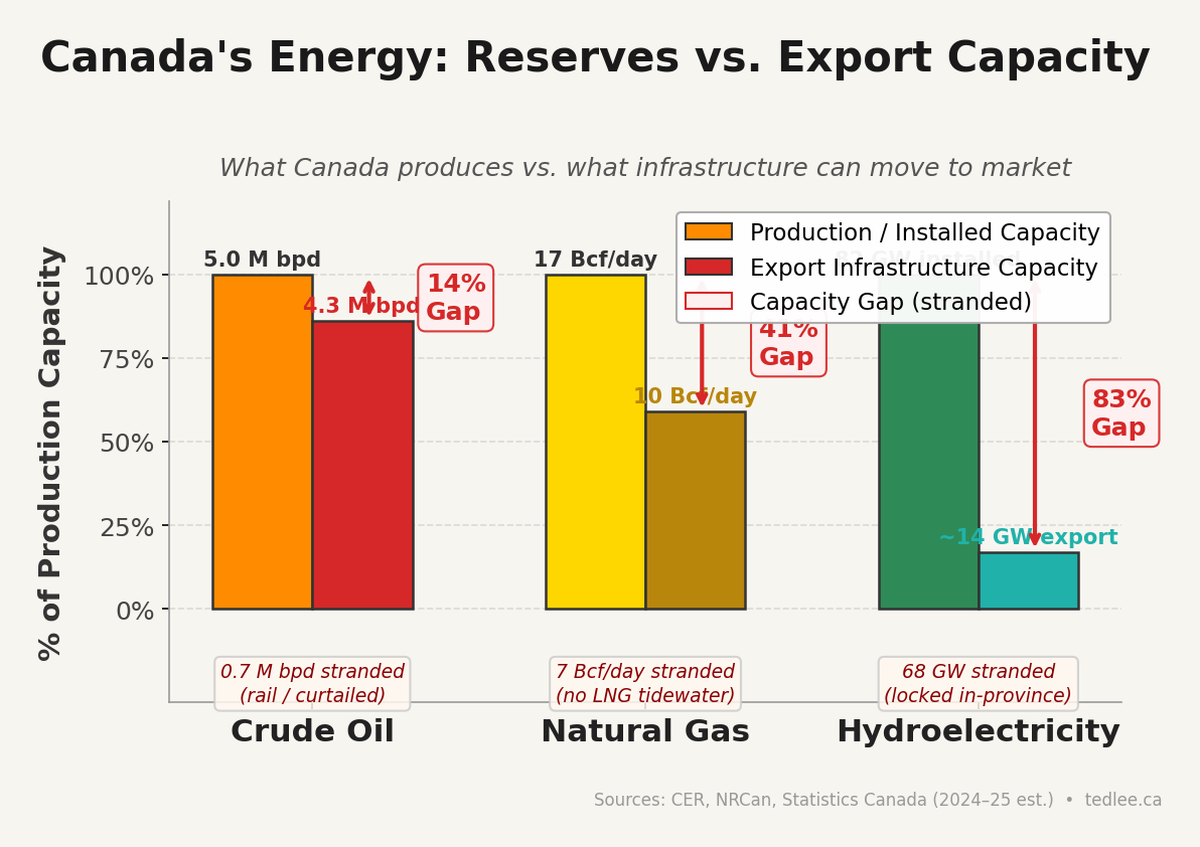
What Canada produces vs. what its infrastructure can move to market.
8. What Citizens Can Do — Practical Steps
Democracy works best when citizens are engaged. Here are practical, nonpartisan ways you can participate in decisions about Canada's energy future and infrastructure.
A brief, respectful letter or email explaining your concerns about energy prices or infrastructure carries real weight. Find your Member of Parliament at canada.ca or your Member of the Legislative Assembly through your provincial government website.
Federal and provincial governments hold public consultations on major infrastructure and energy projects. These are opportunities to speak, write submissions, or simply attend and learn. Check the Canada Gazette and your provincial gazette for notices.
Local ratepayers associations, seniors groups, environmental organizations, and business associations all engage with energy and infrastructure issues. Joining or forming such groups amplifies individual voices.
Follow the legislative process through the Parliament of Canada website (parl.ca), provincial legislative assembly websites, and reliable news sources. Understanding a bill before it passes gives citizens the most opportunity to influence it.
Federal and provincial elections determine who makes these decisions. Review party platforms on energy and infrastructure specifically. Ask candidates direct questions at all-candidates forums.
The Canada Energy Regulator, the National Energy Board (its predecessor), and provincial utilities commissions hold public hearings on major energy projects. Anyone can register to appear or submit a written statement.
9. Visual Aids
The following placeholders indicate where visual graphics would appear in a fully designed version of this document. Each is described in detail so that the information is accessible even without the graphic.
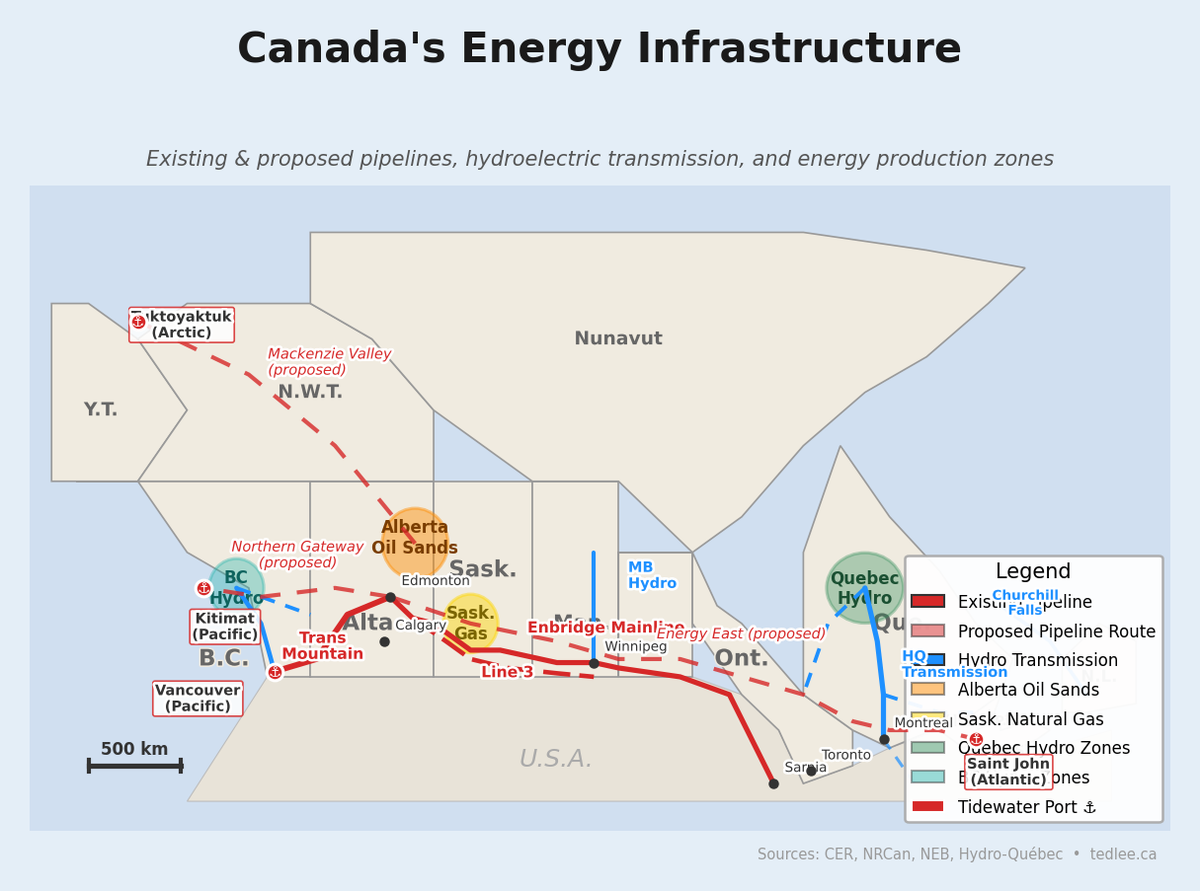
Existing and proposed pipelines, hydroelectric transmission, and energy production zones.
Sources: CER, NRCan, NEB, Hydro-Québec • tedlee.ca
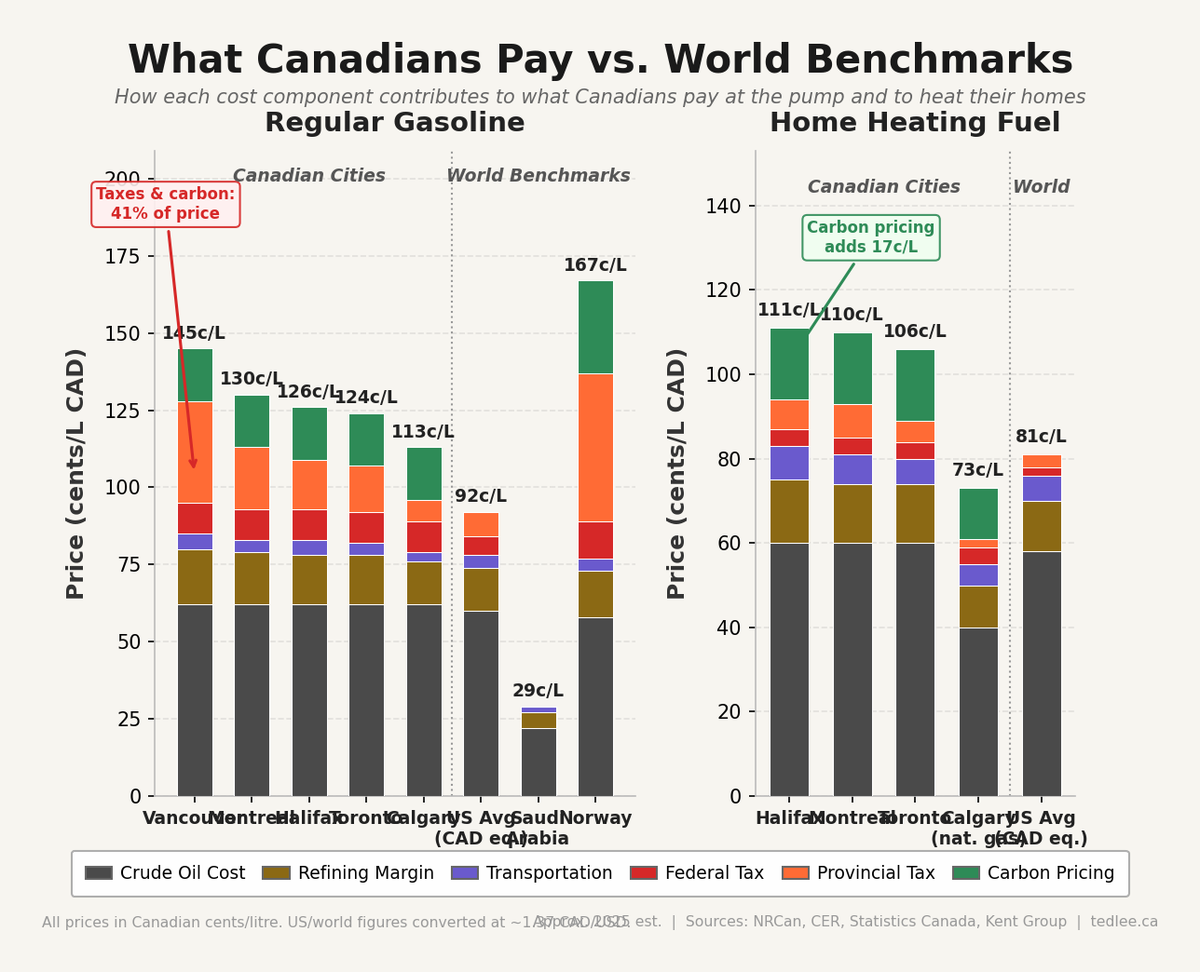
How each cost component contributes to what Canadians pay at the pump and to heat their homes.
Sources: NRCan, CER, Statistics Canada, Kent Group (2025 est.) • tedlee.ca
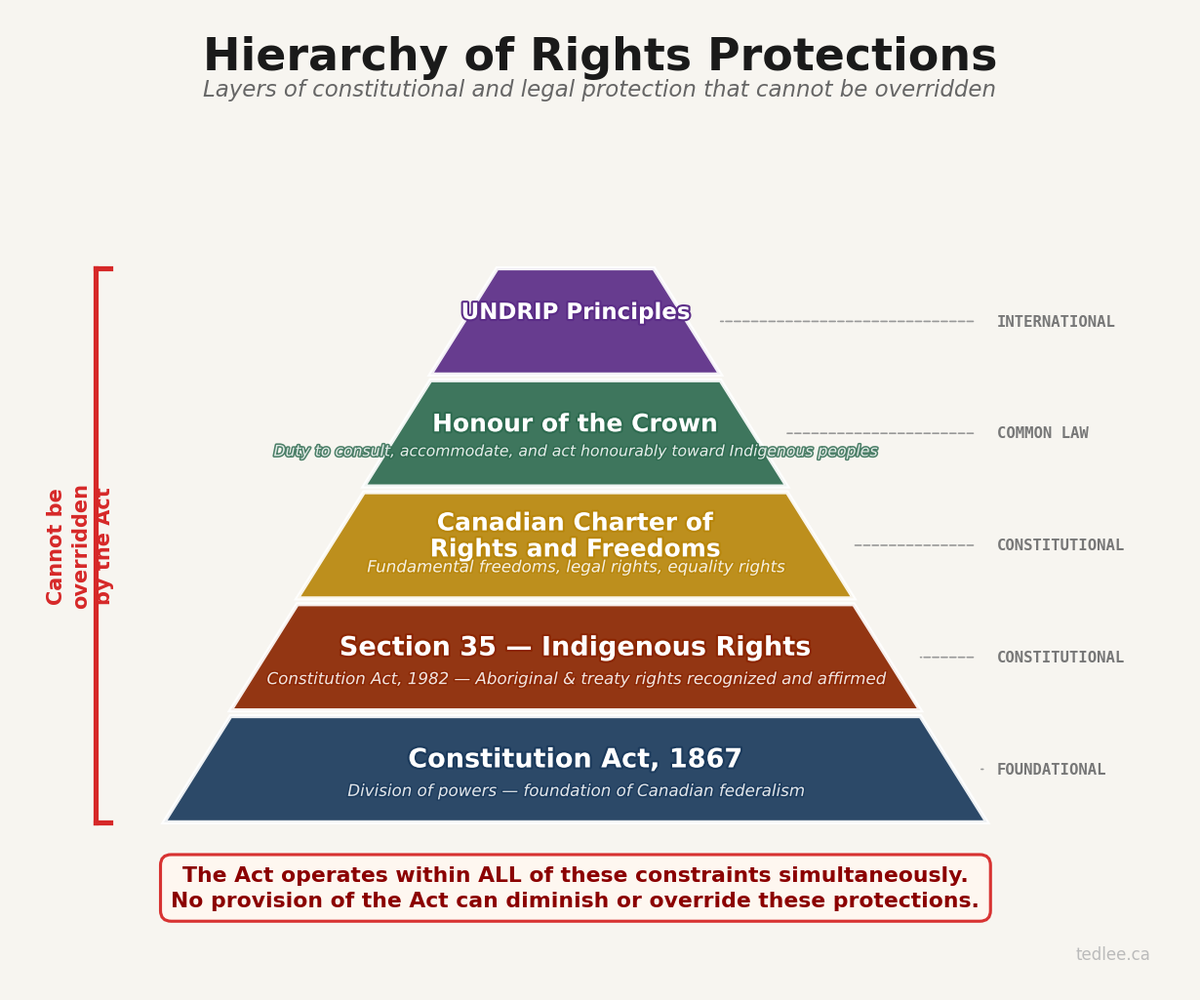
Layers of constitutional and legal protection that cannot be overridden by the Act.
tedlee.ca